Start Here
Best heavy-duty commuter: Himiway D5 2.0 E-BikeBuying Guide
Best E-Bikes for Heavier Riders
Most e-bike weight ratings are quietly modest. Here's how to read the number correctly, and which bikes actually clear a higher bar.
Most e-bike listings advertise a "max payload" front and center, but rarely explain what that number actually includes or what happens if you're near it — which matters more here than on a regular bike, since the frame, spokes, motor, and brakes are all doing more work per pound than they would on a standard commuter.
This guide covers how to read a payload rating correctly, what actually changes on a bike built for higher capacity, and which e-bikes in our shop clear a genuinely higher bar rather than just a marginally higher one.
Decision Point
Payload Capacity vs. Rider Weight LimitLast Checked
2026-08-13Picks from our shop
Choose This If
- Himiway D5 2.0 E-Bike: Comfort, Heavier & Taller Riders, Gravel & Light Trails
- Burchda RX30 AWD Electric Bike: Off-Road & Trails, Hills & Climbing, Long-Distance Touring
- Burchda HC26 AWD Electric Bike: Off-Road & Trails, Hills & Climbing, Hunting & Outdoors
Skip This If
- You want a light, nimble commuter and payload is not the constraint.
- Your rides are pavement, bike lanes, or apartment storage.
- You want a heavy-duty commuter, not a mountain e-bike.
| Detail | Himiway D5 2.0 E-Bike | Burchda RX30 AWD Electric Bike | Burchda HC26 AWD Electric Bike |
|---|---|---|---|
| Fit | Best heavy-duty commuter | Highest payload — trail bike | Highest payload — trail bike |
| Price | $1,999.00 | $1,399.00 | $1,449.00 |
| Best For | Comfort, Heavier & Taller Riders, Gravel & Light Trails | Off-Road & Trails, Hills & Climbing, Long-Distance Touring | Off-Road & Trails, Hills & Climbing, Hunting & Outdoors |
| Key Specs | Hub motor | Class 3 · Hub motor | Class 3 · Hub motor |
Best heavy-duty commuter
9% offHub motorHeavier Riders
- Motor
- Hub
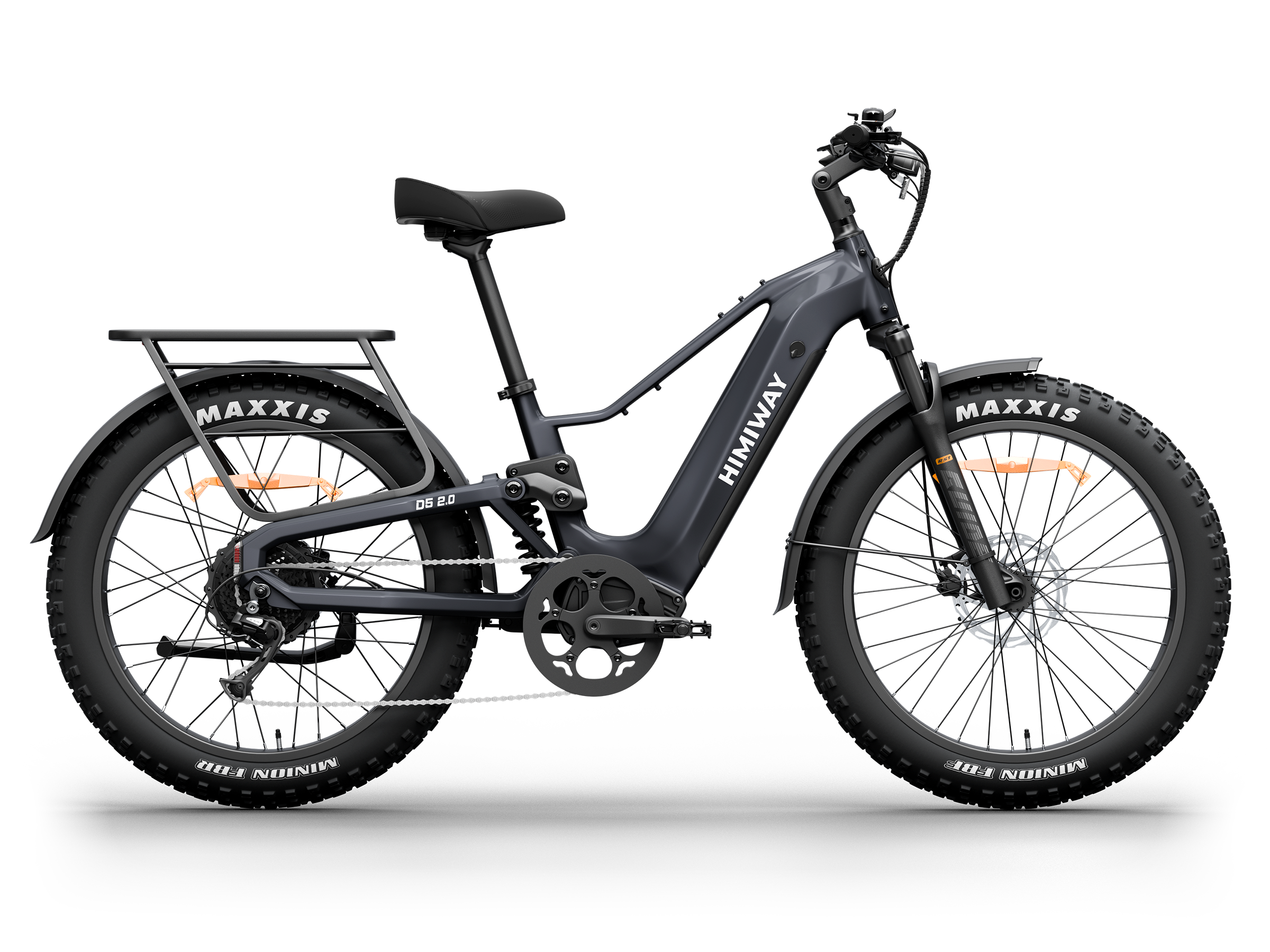
Himiway D5 2.0 E-Bike
$2,199.00$1,999.00Save 9%
- Detail
- Comfort, Heavier & Taller Riders, Gravel & Light Trails
- Detail
- Hub motor
- Detail
- Use: Heavier Riders, Commuting
A full-suspension, all-terrain fat-tire e-bike built for comfort — a 400 lb payload and a 5'1"–6'5" rider range make it a strong fit for larger or taller riders.
Highest payload — trail bike
7% offClass 3Hub motor

- Class
- 3
- Motor
- Hub
Burchda RX30 AWD Electric Bike
$1,499.00$1,399.00Save 7%
- Detail
- Off-Road & Trails, Hills & Climbing, Long-Distance Touring
- Detail
- E-bike class 3
- Detail
- Hub motor
- Detail
- Use: Trail, Hills, Heavier Riders
A long-range dual-motor AWD full-suspension mountain e-bike with up to 80 miles per charge and a 500 lb payload.
Highest payload — trail bike
Class 3Hub motorTrail

- Class
- 3
- Motor
- Hub
Burchda HC26 AWD Electric Bike
$1,449.00
- Detail
- Off-Road & Trails, Hills & Climbing, Hunting & Outdoors
- Detail
- E-bike class 3
- Detail
- Hub motor
- Detail
- Use: Trail, Hills, Heavier Riders
A dual-motor AWD fat-tire mountain e-bike with up to 80 miles of range, full suspension, and a 500 lb payload for rough terrain.
This page contains affiliate links. If you buy through one, we may earn a commission at no extra cost to you. Learn more.
Payload Capacity vs. Rider Weight Limit
The number on a spec sheet is almost always "max payload," not a rider-only weight limit — it's the combined weight of the rider, anything they're wearing or carrying, and anything mounted to a rack or basket. A 400 lb payload rating doesn't mean a 395 lb rider with an empty backpack; it means the rider plus everything else on the bike together shouldn't exceed 400 lb.
This is worth checking directly against a specific listing rather than assuming — manufacturers don't use the term consistently, and a bike's actual page (not just a marketing summary) is the more reliable source for what a number includes.
What Actually Changes on a Higher-Capacity Frame
A bike rated for real capacity generally differs in a few specific ways, not just a bigger number stamped on the same frame: thicker-gauge steel or aluminum tubing, wheels built with more spokes or heavier-gauge spokes to resist flex and breakage, wider tires that spread load over more contact area, and a motor with enough torque to move that added weight from a stop and up hills without straining. Hydraulic disc brakes matter more here too — a heavier total load needs more stopping power, and mechanical brakes lose consistency faster under sustained heavy use.
None of this is usually visible in a product photo, which is why the payload number and the frame/component details in the full spec sheet matter more than how "heavy-duty" a bike looks.
The Highest-Capacity Picks in Our Shop
The Himiway D5 2.0 is the clearest fit if capacity is the main thing you're shopping for: a 400 lb payload paired with full suspension and a stated rider height range of 5'1" to 6'5", which is the only bike in our shop built and marketed around rider size specifically, not just a payload number buried in a spec table.
The Burchda RX30 AWD and HC26 AWD carry the highest raw payload rating we offer at 500 lb, backed by dual-motor all-wheel drive and full suspension. Both are built and marketed as off-road mountain e-bikes first — mud, sand, snow, steep climbs — so they're the better fit if you want maximum capacity and don't mind a trail-oriented ride, rather than a plain heavy-duty commuter.
One Worth Skipping for This Use
The Himiway A7 Pro Commuter, elsewhere a genuinely good bike, is rated to just 300 lb payload — the lowest in our e-bike lineup and a meaningfully different design goal (a lighter commuter frame prioritizing efficiency over load capacity). If capacity is your main constraint, this is the one in our shop to skip, not because it's a bad bike, but because it's built for a different rider.
How We Keep This Guide Useful
We start with the riding problem, then weigh specs that change the real ownership experience: fit, capacity, range, braking, storage, serviceability, and price. Product cards only appear when the product is live and reviewed for the site, and this guide was last checked on 2026-08-13.
FAQ
What payload capacity should I actually look for?
As a starting point, look for a payload rating with real margin above your own weight plus whatever you'll typically carry — riding consistently near the maximum rating isn't what these numbers are tested for. 400 lb payload bikes give a meaningful buffer for most riders; the 500 lb options in this guide give more room still.
What actually happens if I exceed the weight limit?
Nothing dramatic on a single ride, usually — but riding consistently over the rated limit accelerates wear on the frame, spokes, and suspension, increases stopping distance, and can void the manufacturer's warranty if something does fail. It's a real limit to respect, not a conservative marketing number.
Do higher-capacity e-bikes ride differently?
They're generally heavier and less nimble at low speed than a lightweight commuter e-bike, since the frame, motor, and tires built for higher capacity all add weight of their own. In exchange, they typically feel more planted and stable at speed and under load — a reasonable trade for the capacity.
Is a fat-tire e-bike automatically higher capacity?
Not automatically — fat tires help with traction and comfort, but payload capacity comes from the whole build (frame, wheels, motor torque, brakes), not tire width alone. Check the actual payload rating rather than assuming a fat-tire bike is rated higher just because it looks heavy-duty.
Related Guides & Tools
Best E-Bikes for Commuting Under $1,500
The general budget e-bike buying guide this one branches off of.
Hub Motor vs. Mid-Drive Motor E-Bikes
Motor type matters more when a bike is carrying more weight — see how each one actually performs under load.
E-Bike Selector
Answer a few questions about your commute and get a recommended class and motor type.
E-Bikes: The Complete Guide
Every e-bike guide, comparison, tool, and checklist we have, in one place.
Bike & E-Bike Glossary
Payload, motor torque, and other terms from this guide, defined in one place.